Teaching Philosophy
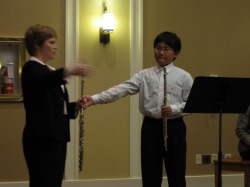
Each student is a valuable human being and is unique. While my role as a teacher includes imparting musical knowledge about repertoire, technical information about instruments and equipment and the like, it is my goal to provide each student with the tools to become aware of his or her learning styles. This includes showing students how to practice effectively, as well as teaching them to respond to adversity and high-pressure situations like auditions and recital performances.
A goal oriented, methodical approach is beneficial to maximize a student’s progress. While I do not have a set regimen for everyone, as each student is different and has varied needs, there are common areas such as scales, technical studies, etudes, excerpts and solo repertoire. I prefer to organize lessons and assignments so students know exactly what the assignment is, why they are doing the particular task, the recommended minimum practice time and how the assignment will be evaluated at the next lesson.
I believe students learn best when they let the conscious part of the brain get out of the way and let the non-thinking parts of the mind and body respond naturally to appropriate stimuli which is the sharply focused mental command of the musical product. Conversely, I feel that a musician cannot produce a musically satisfying performance without a clear concept on what he or she wants to sound like. My role when it comes to teaching how to play the instrument, therefore, is to be the student’s guide. It is vitally important for me to model musical examples for the student, as well as encourage them to listen to as many live concerts and recordings as possible. When students start internalizing the mechanics of how they play or begin a critical internal dialogue, it is my job to get them back on track thinking about the musical product he or she wishes to produce.
When students discover how they learn and how to do it without blocking themselves with internal dialogue or unnecessary isometric muscular tension, playing becomes easy and music a real joy.
A goal oriented, methodical approach is beneficial to maximize a student’s progress. While I do not have a set regimen for everyone, as each student is different and has varied needs, there are common areas such as scales, technical studies, etudes, excerpts and solo repertoire. I prefer to organize lessons and assignments so students know exactly what the assignment is, why they are doing the particular task, the recommended minimum practice time and how the assignment will be evaluated at the next lesson.
I believe students learn best when they let the conscious part of the brain get out of the way and let the non-thinking parts of the mind and body respond naturally to appropriate stimuli which is the sharply focused mental command of the musical product. Conversely, I feel that a musician cannot produce a musically satisfying performance without a clear concept on what he or she wants to sound like. My role when it comes to teaching how to play the instrument, therefore, is to be the student’s guide. It is vitally important for me to model musical examples for the student, as well as encourage them to listen to as many live concerts and recordings as possible. When students start internalizing the mechanics of how they play or begin a critical internal dialogue, it is my job to get them back on track thinking about the musical product he or she wishes to produce.
When students discover how they learn and how to do it without blocking themselves with internal dialogue or unnecessary isometric muscular tension, playing becomes easy and music a real joy.